 Polymarket
 potential returns at different entry prices
Polymarket entry prices determine the amount at risk and the potential profit from an outcome share’s final payout. For a position held through a full winning resolution, gross profit equals the payout minus the purchase cost. Percentage return divides that profit by the amount paid. A lower entry price increases that conditional return, while the outcome can still lose. Fees, execution prices, and split resolutions can change the amount ultimately received.
With complete fills and no fees, a lower entry price buys more shares for the same budget.
Entry cost and the full-payout calculation
The calculation combines the price paid, the quantity purchased, and the payout for that outcome. Costs and redemption amounts here use pUSD, the USDC-backed collateral token on Polygon. Buying a share creates exposure to its market’s specified condition. The final payout follows that condition’s resolution rules.
Profit per share
For a full winning payout of 1 pUSD, gross profit per share is
1 - p
, where
p
is the entry price in pUSD. For
C
shares, gross profit is
C * (1 - p)
. These formulas assume every purchased share receives the full payout and exclude fees.
Percentage return
Gross percentage return is
((1 - p) / p) * 100
for a positive entry price. Purchase cost is the denominator.
A losing position with a zero payout loses its entire purchase cost before any additional charges.
What does a lower entry price change?
A lower entry price reduces the purchase cost and increases full-payout profit when the share quantity and winning outcome remain the same. It also reduces the maximum purchase-cost loss for that fixed quantity. Neither relationship establishes that the outcome will win.
Share prices express market-implied probabilities. A cheaper outcome therefore combines a larger conditional percentage gain with a lower market-implied chance of receiving the full payout. Whether the price represents an attractive opportunity requires an assessment of the specified outcome, including the terms that determine its settlement.
A 137-share comparison at 40¢ and 60¢
In this hypothetical comparison, purchasing 137 shares at 40¢ produces 82.20 pUSD in gross profit after a full winning payout. The alternative entry price is 60¢ for the same quantity. Both purchases assume complete fills at their stated prices, a subsequent full payout, and no fees.
Entry at 40¢
The purchase costs
137 * 0.40 = 54.80
pUSD. Redemption returns
137 * 1 = 137
pUSD. Subtracting the purchase cost leaves 82.20 pUSD in gross profit, or
(82.20 / 54.80) * 100 = 150%
of the amount paid.
Entry at 60¢
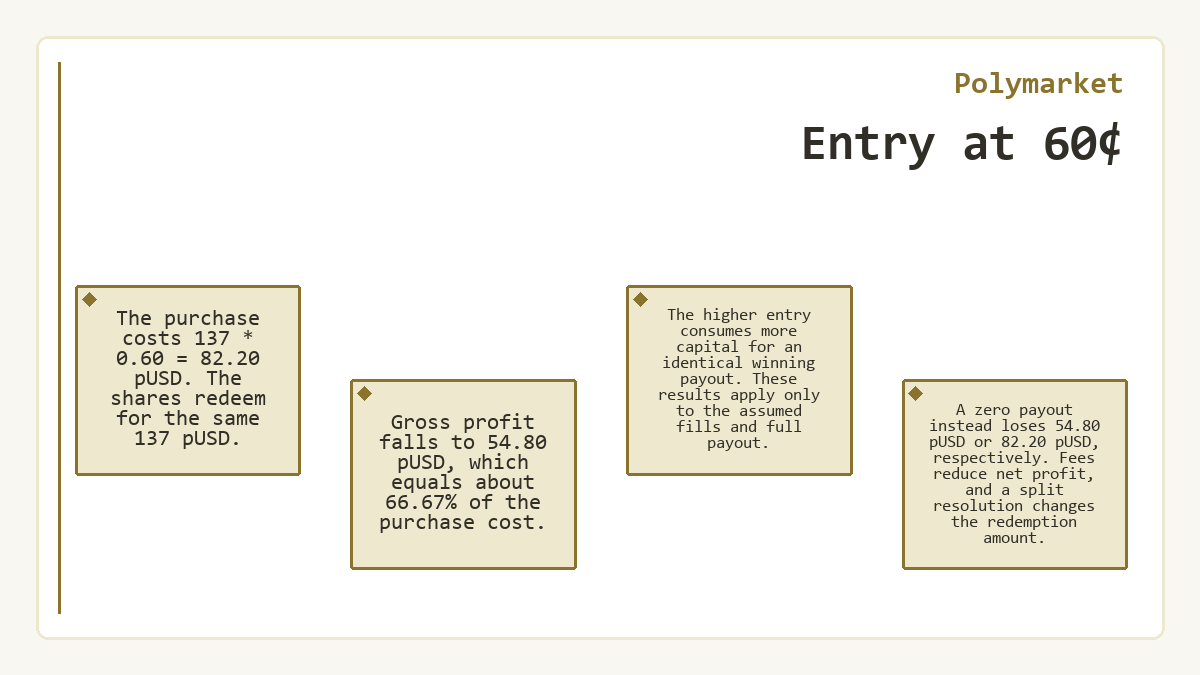
The purchase costs
137 * 0.60 = 82.20
pUSD. The shares redeem for the same 137 pUSD. Gross profit falls to 54.80 pUSD, which equals about 66.67% of the purchase cost. The higher entry consumes more capital for an identical winning payout.
These results apply only to the assumed fills and full payout. A zero payout instead loses 54.80 pUSD or 82.20 pUSD, respectively. Fees reduce net profit, and a split resolution changes the redemption amount.
Equal share counts and equal budgets
Holding the share count constant
Comparing an identical quantity isolates the entry price’s effect on cost. The lower-priced purchase requires less capital, while both positions receive the same total redemption if they obtain the full winning payout. Their maximum purchase-cost losses differ because their initial costs differ.
This comparison answers how much the same exposure costs. It doesn’t describe how two equal spending budgets perform.
Holding the budget constant
With a fixed pre-fee budget
B
, the theoretical quantity is
B / p
. A lower entry price purchases more shares. Full-payout proceeds rise with that quantity, while a zero payout consumes the same initial budget in either case.
Available liquidity, size constraints, and fees can prevent an order from acquiring that theoretical quantity. A comparison that holds spending constant must use the shares actually purchased. It also needs the same definition of costs on both sides.
Execution prices and position valuations
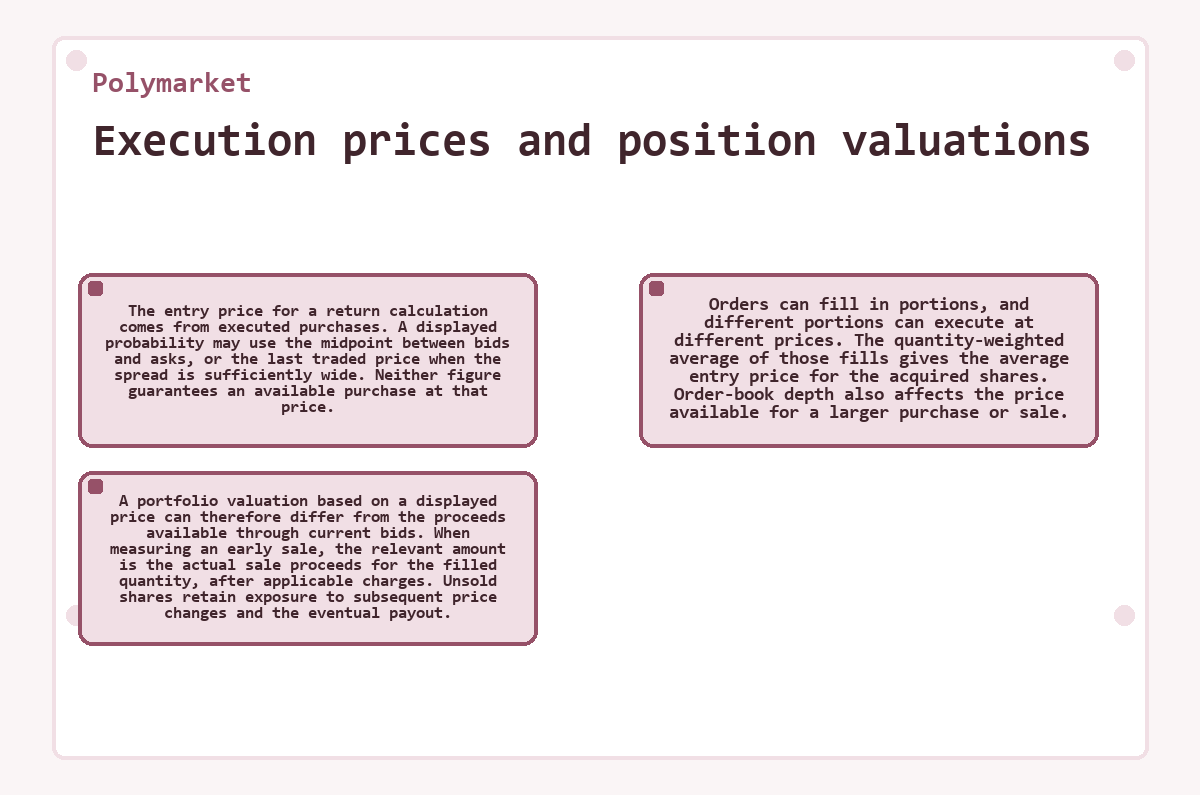
The entry price for a return calculation comes from executed purchases. A displayed probability may use the midpoint between bids and asks, or the last traded price when the spread is sufficiently wide. Neither figure guarantees an available purchase at that price.
Orders can fill in portions, and different portions can execute at different prices. The quantity-weighted average of those fills gives the average entry price for the acquired shares. Order-book depth also affects the price available for a larger purchase or sale. A portfolio valuation based on a displayed price can therefore differ from the proceeds available through current bids. When measuring an early sale, the relevant amount is the actual sale proceeds for the filled quantity, after applicable charges. Unsold shares retain exposure to subsequent price changes and the eventual payout.
Trading fees and net results
Net profit deducts applicable costs from the position’s gross result. Fee-enabled markets charge takers, while makers pay no trading fee. The applicable charge depends on the market’s fee settings, the share price, and the number of shares traded. A limit order can take liquidity if it matches existing orders immediately.
For a position held through redemption, the calculation starts with the redemption proceeds and subtracts acquisition costs and applicable charges. Selling before resolution introduces a separate execution whose charges can also affect the result. The spread already influences purchase and sale prices; subtracting it again after using actual fills would count that effect twice.
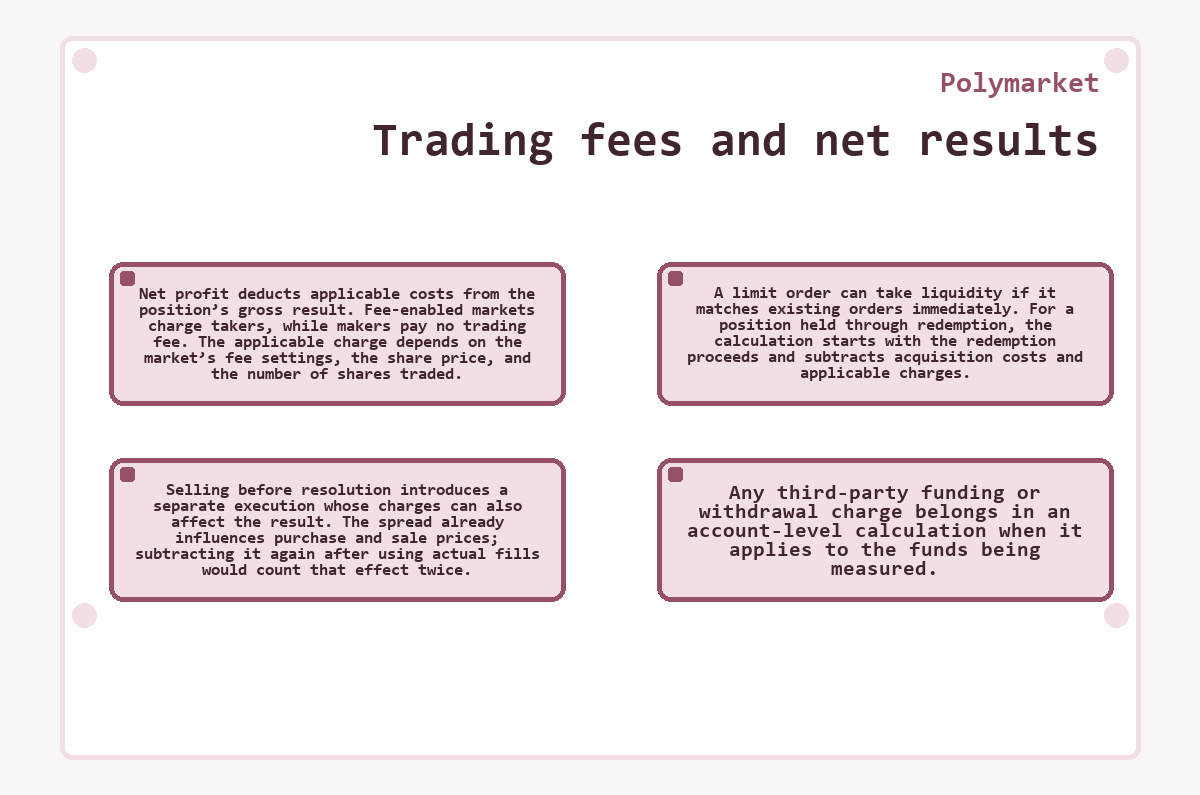
Any third-party funding or withdrawal charge belongs in an account-level calculation when it applies to the funds being measured.
Full payouts, split payouts, and market rules
After a full binary resolution, each winning share redeems for 1 pUSD. Some binary markets can instead resolve to a split payout. In that case, each side receives its recorded share of the collateral, and the full-payout profit formulas no longer describe the result.
In a negative-risk group, exactly one market resolves Yes, and every other market resolves No. These markets don’t split payouts. The rules that define the market’s condition therefore matter alongside its entry price. A positive redemption amount can still produce a loss when it falls below the purchase cost.
A market’s end date can mark eligibility for resolution; it doesn’t establish an immediate redemption time.
Probability estimates and the break-even price
For a position that can only pay 1 pUSD or zero, an assumed win probability determines its expected payout. Let
q
represent that probability as a fraction, and
p
the entry price in pUSD. Expected gross profit per share is
q - p
pUSD.
Before fees, this model breaks even when the assumed probability equals the entry price numerically. Fees raise the required probability. The model excludes split payouts and rewards, and its answer depends on the probability estimate. Reading the displayed price as that same estimate doesn’t establish an advantage over the market.
Are these returns annual interest rates?
A position’s percentage return measures its gain or loss against entry cost, without defining an annual interest rate. Two positions with the same percentage gain can commit funds for different durations. For UMA-resolved markets, an outcome dispute can delay final resolution and redemption.
Holding rewards, maker rebates, and liquidity rewards have separate eligibility and calculation rules. They don’t increase a share’s full redemption payout. An incentive can add to the overall result when the position or activity qualifies, but a projected reward remains separate from an amount actually received. Extrapolating one winning trade across a year assumes repeat opportunities, similar execution, and repeated winning outcomes that the entry-price calculation doesn’t establish.
Polymarket - common questions
Does choosing No change the potential-return formula?
Yes and No shares use the same profit formula when the chosen outcome receives a full payout. Entry price, acquired quantity, applicable costs, and final payout determine the result. A No position wins when the market’s specified condition doesn’t occur; its label doesn’t create a different percentage-return calculation.
Can an accepted order already count as a completed purchase?
An accepted order doesn’t establish a completed purchase for a return calculation. A delayed order may have no fills, and a matched trade can still await onchain settlement. Use the shares and acquisition costs from confirmed fills when calculating the result of a completed purchase. An unfilled order adds no purchased shares.
How should a partial sale affect the reported return?
A partial sale realizes a result only for the shares that actually sell. Compare their sale proceeds with the acquisition cost assigned to that quantity, including applicable fees. The remaining shares retain their own exposure. Combining realized profit with the unsold position’s estimated value requires identifying both amounts separately.
What profit does merging Yes and No shares realize?
Merging a complete Yes/No set returns 1 pUSD, so gross profit equals that amount less the combined acquisition cost of both shares. The balances must concern the same market, and the merged quantities must match. Costs from acquiring both sides remain part of the net-result calculation, even though merging avoids a sale.
Are maker rebates a fixed return on the amount spent?
Maker rebates depend on executed maker liquidity in eligible markets, rather than a fixed percentage of purchase spending. Calculations compare fee-curve-weighted contributions within each market. Payouts use pUSD and require at least 1 pUSD in accrued rebates. Resting orders that never fill don’t qualify for maker rebates. Liquidity rewards use separate rules, so qualifying for one program doesn’t establish eligibility for another.
Last updated: